Blog
Drones: A Valuable Tool in CMCD’s Fight Against Mosquitoes
Drones: A Valuable Tool in CMCD’s Fight Against Mosquitoes
Atom Rosales
Director of Technical Development
At Collier Mosquito Control District (CMCD), we use every tool available to protect residents from the nuisance and health risks posed by mosquitoes. One of the most innovative tools in our Integrated Mosquito Management (IMM) program is drones!
Why Drones Matter
Drones, also known as unmanned aerial systems (UAS), have become an important part of modern mosquito control because they are easy to use, cost-effective, and able to fly while being piloted from the ground. Drones can be equipped with advanced high-resolution cameras and sophisticated sensors that capture detailed images of the land to precisely identify potential areas where mosquito larvae may be present (Carrasco-Escobar et al, 2022; Stanton et al, 2021; Valdez-Delgado et al, 2023). This technology helps mosquito control teams spot hidden or hard-to-reach areas where mosquito larvae may be developing, making it easier to target and treat problem spots before they grow into bigger mosquito populations. Additionally, they can be used for precise aerial larvicide treatments in hazardous and difficult to reach areas for ground crews, yet too small to justify helicopter use.
How CMCD Uses Drones
Since 2018, CMCD has steadily expanded its drone program to cover the District’s 700+ square miles of diverse habitats. These include mangroves, cypress wetlands, and agricultural fields, which are prime breeding grounds for several target mosquito species. All drones used by the District comply with stringent state security standards, ensuring the utmost safety and integrity of our operations and networks.
Today, our fleet includes three American-made drone platforms that service different purposes:
- Two Skydio drones (Skydio, San Mateo, CA, USA) for high-resolution mapping and quick inspections of mosquito breeding habitat.
- One Inspired Flight 1200A drone (Inspired Flight Technologies, San Luis Obispo, CA, USA) with light-detection-and-ranging (LiDAR) technology to map mosquito breeding habitat in 3D.
- Two PrecisionVision 40X treatment drones (Central UAS Technologies, Daytona Beach, FL, USA) designed to carry and apply up to 40 pounds of mosquito larvicide with pinpoint accuracy.
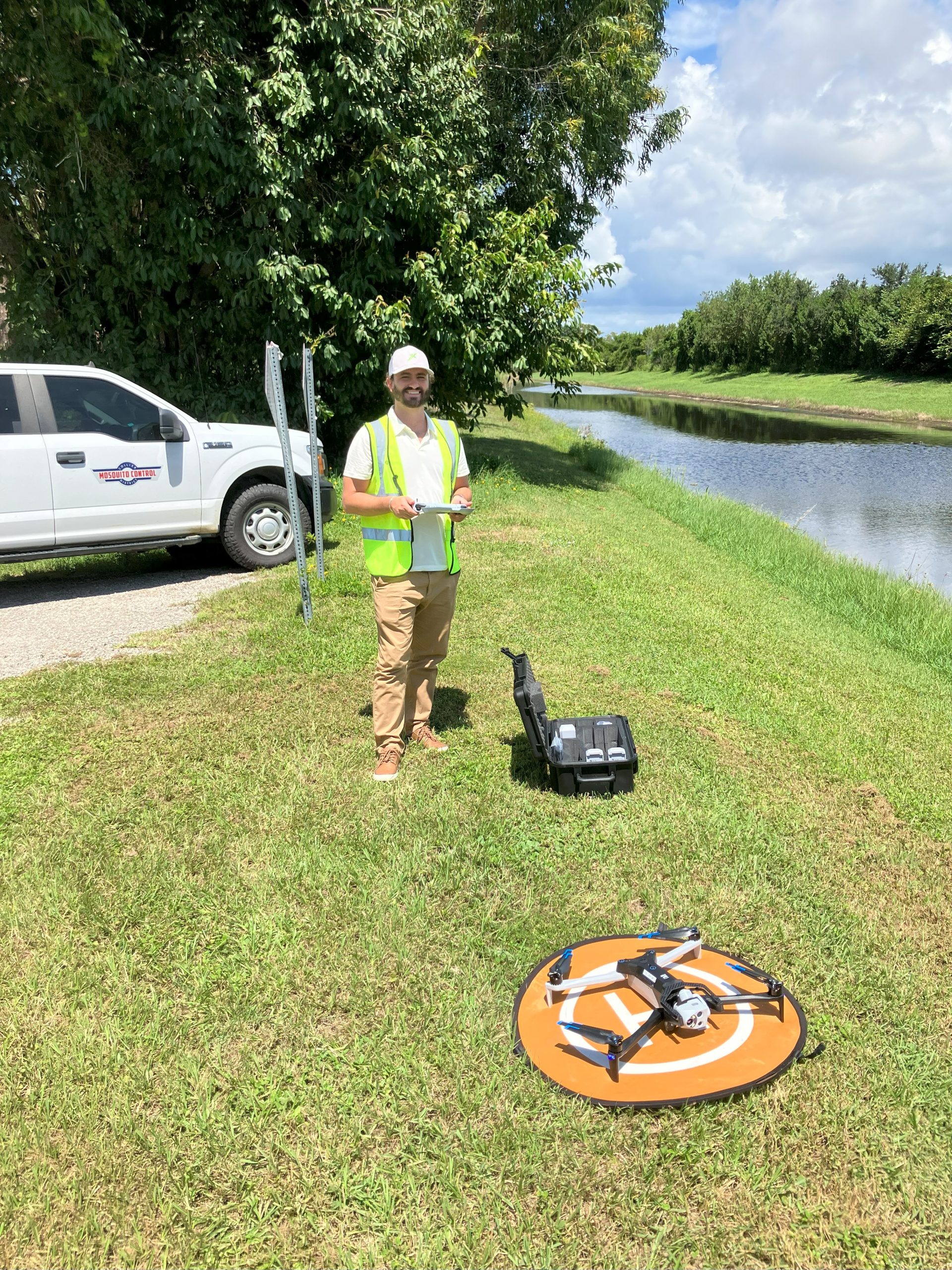
Our Skydio drones give field staff a bird’s-eye view of areas that can’t be seen from roads or the edges of swamps. With their high-resolution cameras, these drones help us check whether mosquito breeding sites are holding water. Many of our field technicians are trained to operate these drones, allowing them to quickly spot problem areas. This ensures that larvicide treatments are applied only where water is present, making our mosquito control efforts both effective and efficient. These drones are also used for pre-treatment reconnaissance, helping us identify obstacles or potential hazards that either manned or unmanned aircraft might encounter during larvicide treatment missions.
Our Inspired Flight 1200A drone is one of the most advanced tools in our fleet. This drone was purchased with Centers for Disease Control and Prevention (CDC) funding from the Epidemiology and Laboratory Capacity (ELC) for Prevention and Control of Emerging Infectious Diseases program, which awarded the District funds to expand our ability to detect and monitor mosquito habitats. Using LiDAR technology, it can create detailed elevation maps that allow us to pinpoint mosquito breeding sites with remarkable accuracy. This capability allows us to target mosquitoes at the source with larvicide before they become adults and have the chance to transmit disease to humans.
The PrecisionVision 40X drone is designed to treat mosquito breeding areas that are hard to reach. It can carry up to 40 pounds of Bacillus thuringiensis israelensis (Bti)-based larvicide, which is derived from a naturally occurring bacterium, and apply it with precision to areas that are oddly shaped or filled with obstacles. This technology has proven to be effective at controlling mosquito larvae, including species that spread diseases, by safely delivering treatments exactly where they’re needed (Lucas et al, 2021; Munyakanage et al, 2024).
After a few challenging years adapting to state legislation and upgrading equipment to meet new regulatory standards, our drone program has taken off with great success this year! So far, drones have treated more than 1,000 acres of mosquito breeding habitat across Collier County. Their ability to reach small, hard-to-access areas makes them especially valuable, since these spots can lead to large mosquito populations if left untreated. Treatments have focused on places where mosquitoes thrive, such as retention/detention ponds, flooded farm fields, canals with invasive aquatic plants, and wet forests near communities.
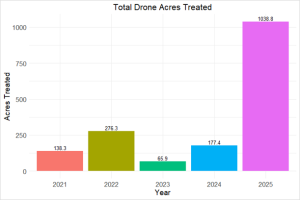
Figure 1: Total acres treated by targeted drone operations to date (9/9/25). Drone operations were suspended in 2023 due to new state legislative and regulatory requirements.
Safety and Responsibility
Because drones operate in the national airspace, our program follows strict regulations from the Federal Aviation Administration (FAA), the Florida Department of Agriculture and Consumer Services (FDACS), the Florida Department of Management Services (DMS) and state privacy laws. Our drone pilots are FAA-certified, our aircraft are registered, and every mission follows detailed safety procedures. All larvicide applications comply with state and federal pesticide laws, with careful recordkeeping for accountability and transparency.
Looking Ahead
Drones have quickly proven themselves to be a core part of mosquito management in Collier County. By filling the “middle ground” between manned aircraft and ground operations, they allow us to act quickly, safely, and precisely where mosquitoes are most likely to affect people. As drone technology continues to advance, CMCD is committed to expanding its use to better safeguard our community.
References
Carrasco-Escobar G, Moreno M, Fornace K, Herrera-Varela M, Fernando E, Conn JE. (2022) The use of drones for mosquito surveillance and control. Parasites & Vectors, 15(1).
Munyakanage D, Niyituma E, Mutabazi A, Misago X, Musanabaganwa C, Remera E, Rutayisire E, Ingabire MM, Majambere S, Mbituyumuremyi A, Ngugi MP, Kokwaro E, Hakizimana E, Muvunyi CM. (2024) The impact of Bacillus thuringiensis var. israelensis (Vectobac® WDG) larvicide sprayed with drones on the bio-control of malaria vectors in rice fields of sub-urban Kigali, Rwanda. Malaria Journal, 23(1).
Lucas KJ, Brake P, Grant S, Lake L, Bales RB, Ryan R, Phillips N, Linn P. (2020) Characterization and efficacy of VectoBac® WDG applications targeting container-inhabiting mosquitoes utilizing Unmanned Aerial Vehicles. J Florida Mosq Control Assoc. 67: 84-90.
Stanton MC, Kalonde P, Zembere K, Hoek Spaans R, Jones CM. (2021) The application of drones for mosquito larval habitat identification in rural environments: a practical approach for malaria control? Malaria Journal, 20(1).
Valdez-Delgado KM, Garcia-Salazar O, Moo-Llanes DA, Izcapa-Treviño C, Cruz-Pliego MA, Domínguez-Posadas GY, Armendáriz-Valdez MO, Correa-Morales F, Cisneros-Vázquez LA, Ordóñez-González JG, Fernández-Salas I, Danis-Lozano R. (2023). Mapping the Urban Environments of Aedes aegypti Using Drone Technology. Drones, 7(9), 581.
—
Atom Rosales serves as the Director of Technical Development at the Collier Mosquito Control District, where he leverages his background in operational mosquito control to advance the District’s use of innovative technologies. He specializes in geographic information system (GIS) applications, treatment application navigation systems, drone operations, and other emerging tools that enhance the District’s effectiveness. Atom is also in the final stages of completing a Master of Science in Spatial Data Science from Penn State University, further strengthening his expertise in applying data-driven solutions to mosquito control.