
Blog
How Drift Modeling Ensures Precise Mosquito Control Treatments
How Drift Modeling Ensures Precise Mosquito Control Treatments
By Patrick Linn, MS, MSHAPI
Executive Director
The atmosphere is dynamic by nature, constantly changing. Wind, pressure, humidity and temperature rarely hold steady for long. At any given moment, if you drop a feather from a 500-foot-tall tower, the path that feather takes toward earth will be subject to the whims of the atmosphere. It will move with the wind, perhaps even rise before it begins to fall again.
To be effective when treating for adult mosquitoes – with roughly half an ounce of material per acre – it is incredibly important to be sure the material used goes where intended. Today, we’ll talk a little about the science behind accurate treatment in a dynamic atmosphere.
When treating adult mosquitoes from an aircraft, not only is the quantity of material (per acre) exceedingly small, so too are the droplets. The droplets we use measure about 20-40 microns on average; that’s about the width of a human hair, or the size of a droplet in a cloud.
Accurately predicting where the treatment material will go when released from the aircraft is surprisingly well-established. The U.S. Environmental Protection Agency provides mathematical drift models for us to use given the weight and droplet size of the material (EPA, 2025)
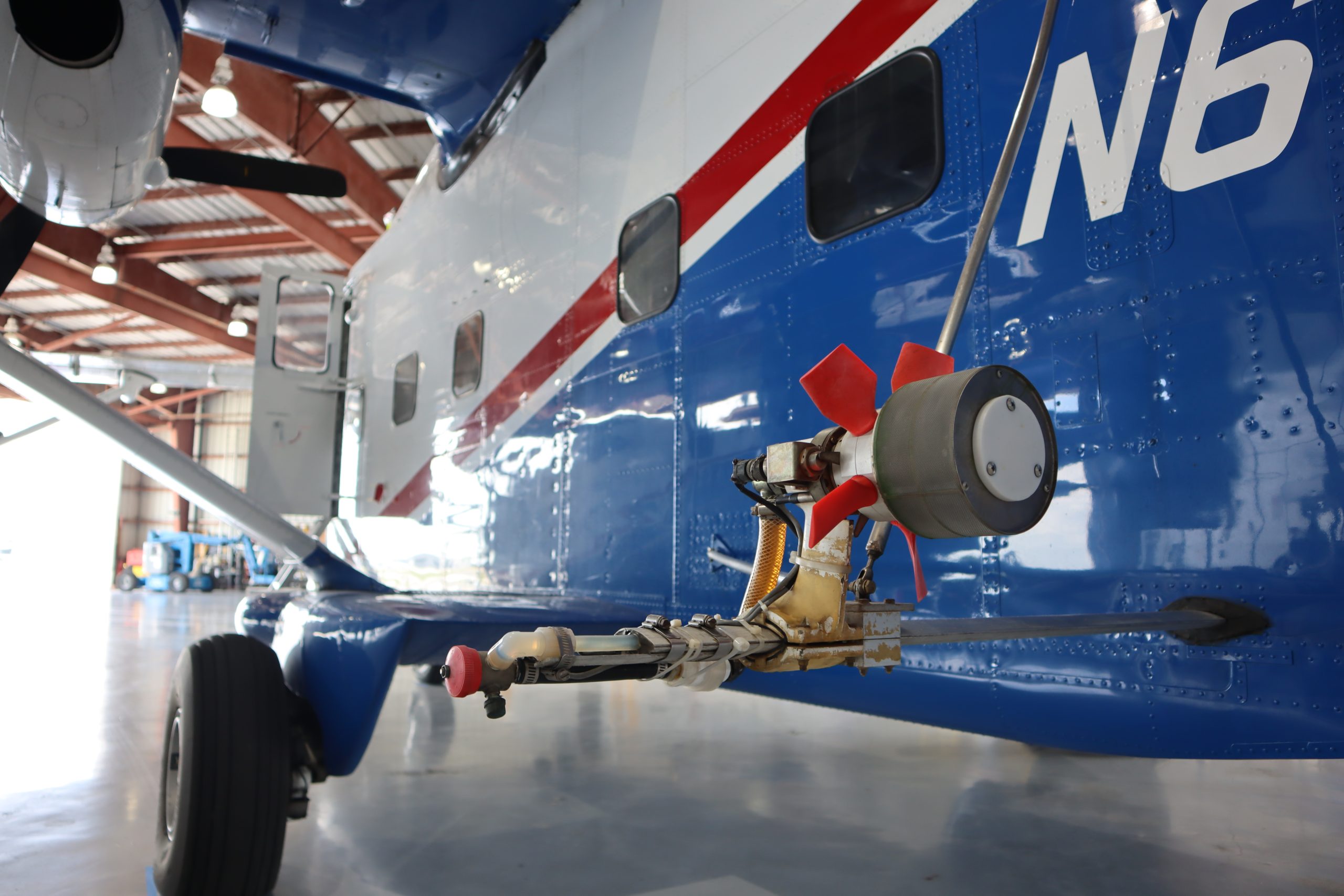
On board the aircraft, we have a sophisticated GPS system which provides our pilots with an “offset” and guides aircraft to within one foot accuracy. Further, the system automatically varies its flow rate with the speed of the aircraft as well as switching on and off as each run is made within the treatment box.
Adulticide treatment materials degrade rapidly in the atmosphere, generally within two hours. This is the reason why treatment needs to occur when mosquitoes are most active.
Why you might see or hear a mosquito control plane overhead, even if you weren’t scheduled for treatment:
Just because an aircraft flies over your home doesn’t mean it was spraying. Our onboard systems are fully automated, using GPS and advanced computer modeling to turn the spray system on and off only when the spray will reach the designated treatment block. If you heard or saw a low-flying aircraft overhead and you are outside the designated treatment area, one of three things likely occurred:
- Traveling to the treatment area
Aircraft may have been passing over your area on the way to the treatment block, and material is not released during that time.
- Turning outside the treatment block
Large aircraft need space to make wide turns and gain speed before lining up for the next spray pass. These turns occur outside of the treatment block, but no treatment material is released during that maneuver.
- Offsetting for wind and altitude
To ensure spray droplets travel to where they’re intended, aircraft don’t fly directly over the treatment block. Instead, they fly slightly offset, a position calculated through advanced drift modeling. These models account for multiple critical factors, such as aircraft type, wind speed and direction at altitude, aircraft speed, droplet size, and material density, to determine the precise offset required. This information then guides the pilot on exactly where to place each spray run. The process is fully automated and rooted in science – not guesswork – delivering accuracy, consistency, and confidence in every application.
Why Flight Trackers Don’t Show When We’re Spraying
Websites like FlightAware or FlightRadar24 use signal data from aircraft transponders and ground stations to draw a map of where planes are flying. They work well for high-altitude commercial flights, but they’re much less reliable for low-flying aircraft like ours, because the signals can be cluttered or temporarily obstructed by structures on the ground. The curvature of the earth actually plays a role in loss of accuracy due to “line of sight”, even within a few miles.
It’s best to think of these websites as a cartoon sketch of our aircraft’s movement. They give a rough idea of where we’ve flown, but they lag behind real-time and are often less accurate during mosquito control missions. Most importantly, these websites are not connected to our navigation or spray systems. That means they can’t show when our spray system is on or off, or where treatments are actually applied according to drift.
Our pilots don’t rely on FlightAware, FlightRadar24, or any other public flight tracker. Instead, they use advanced onboard navigation systems with drift modeling, which automatically turn the spray system on and off inside the treatment block with pinpoint accuracy.
And those changing flight path colors? They’re often misunderstood:
- On FlightAware, green lines simply mean the aircraft is actively transmitting a signal. White or broken lines show estimated positions when coverage is limited.
- On FlightRadar24, the colors indicate altitude, with white for the lowest levels, then yellow, green, blue, purple, and red for progressively higher altitudes. A dotted black line means the aircraft is outside coverage and the position is being estimated.
Bottom line: Drift isn’t random or indiscriminate, it’s modeled, measured, and managed, and flight-tracking websites can show where our aircraft have flown, but they cannot tell you if, when, or where mosquito control treatments are being applied.
References
Dukes J, Zhong H, Greer M, Hester P, Hogan D, Barber JAS. (2004) A comparison of two spray nozzle systems used to aerially apply the ultra-low-volume adulticide fenthion. J Am Mosq Control Assoc. 20(1): 27-35.
Environmental Protection Agency [EPA]. Models for Pesticide Risk Assessment. Available online at: https://www.epa.gov/pesticide-science-and-assessing-pesticide-risks/models-pesticide-risk-assessment#atmospheric
Thistle HW. (2000) The role of stability in fine pesticide droplet dispersion in the atmosphere: a review of physical concepts. Trans ASAE. 43:1409–13.
—
Patrick Linn joined the Collier Mosquito Control District as a pilot in 2007. Since 2016, he has served as the District’s executive director. He has more than 35 years of aviation experience and has flown hundreds of treatment missions using drift modeling to target mosquitoes.