
Blog
The Buzz about Honey Bees and Mosquito Control
The Buzz about Honey Bees and Mosquito Control
Keira J. Lucas, PhD
Deputy Executive Director
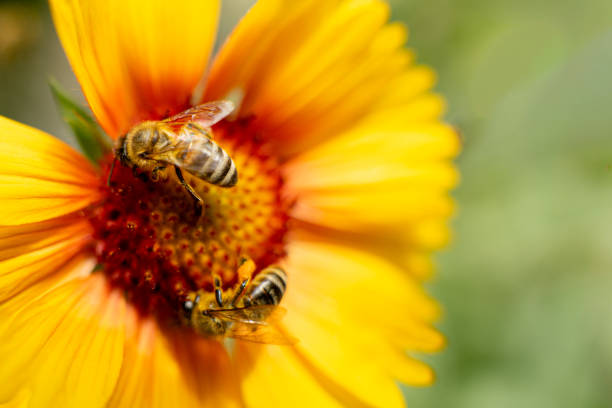
When it comes to understanding how mosquito control affects other species, few have been studied more closely than the honey bee. These hardworking pollinators, though not native to the United States, play a crucial role in our agricultural economy by pollinating countless crops and producing the honey we enjoy. In recent years, honey bee populations have faced alarming declines, sparking worldwide concern and extensive scientific research. Because mosquito control products often contain broad-spectrum pesticides, some people worry that these treatments harm honey bees and contribute to colony collapse.
It’s important to remember that mosquito control programs aim to keep honey bee colonies healthy while reducing the risk of mosquito-borne diseases and keeping our state a comfortable place to live, work, and visit. At the Collier Mosquito Control District (CMCD), many of our staff entered this field out of a love for insects, including honey bees! We employ a diverse team of scientists, from entomologists to environmental scientists, who work together toward a shared goal: to protect public health and comfort while practicing responsible environmental stewardship and respecting pollinators.
So, the question remains: Is mosquito control really to blame for the honey bee’s troubles?
Do mosquito control treatments impact honey bees?
The mosquito control products most often questioned are adulticides, which are products used to target adult mosquitoes. And for good reason! When these products are used incorrectly, they can indeed cause harm! One tragic incident in South Carolina resulted in the loss of 2.3 million foraging bees across 46 hives after a mosquito control product was applied during the daytime (Daley, 2016). This event highlights why it’s essential to follow all product label directions and to notify local beekeepers before treatments occur so they can take precautions.
However, when used correctly, scientific research shows that mosquito control applications have little to no lasting impact on honey bees, but are still exceedingly effective against mosquitoes (Hester et al. 2001, Zhong et al. 2004, Boyce et al. 2007, Chaskopoulou et al. 2014, Rinkevich et al. 2017, Pokhrel et al. 2018, Crowder et al. 2025).
In one 2017 study, scientists exposed mosquitoes and honey bees in cages to four commonly used mosquito control products applied by truck at different distances (Rinkevich et al. 2017). The results were reassuring: mosquitoes were effectively controlled, while honey bee deaths remained very low, even at close range. Beyond about 200 feet, there was little to no impact on bees at all. A follow-up study in 2018 found similar results, in which honey bee colonies showed no signs of poor colony health or pesticide exposure after truck-based applications (Pokhrel et al. 2018).
In 2000, scientists in Manatee County, Florida, studied how nighttime aerial mosquito control applications using Dibrom (naled) affected honey bee hives using modern ultra-low volume methods (Zhong et al. 2004). They placed hives in treated areas, and measured how much of the product settled on the ground and how many bees died afterward. The study found that bee deaths only increased when large amounts of the product were present and when bees were gathered outside their hives during the application. In most cases, residue levels were much lower, and there was no difference in bee deaths or honey production between treated and untreated hives.
A more recent two-year study in Salt Lake City, Utah, also examined how aerial applications of Dibrom affected honey bee health (Crowder et al. 2025). Researchers placed hives both inside and outside areas where mosquito control applications occurred and monitored bee health over time. The findings were encouraging: colonies in treated areas were just as healthy as those in untreated locations, with no significant differences in bee deaths, hive resources, or parasite levels. The researchers found that fungal infections, high temperatures, and seasonal changes were much greater factors in bee health than mosquito control applications.
The research above applies to mosquito control programs that carefully follow science-based practices, like those used by CMCD. It doesn’t apply to every type of chemical use or application method. What we know from many studies is that diseases and parasites (such as Varroa mites), not mosquito control, are the main reasons for poor honey bee colony health (Crowder et al. 2025, Lamas et al. 2025). When mosquito control products are used properly and responsibly, they pose little to no risk to honey bee colonies.
What Beekeepers in Florida Should Know
In Florida, all beekeepers are required by law to register their hives with the Florida Department of Agriculture and Consumer Services (FDACS). FDACS inspectors help ensure that hives are healthy and free from pests, viruses, and invasive bee species. Beekeepers can also work with the agency to identify any possible pesticide exposure.
If you’re a hobby beekeeper, it’s important to take time to learn and follow best management practices to keep your colonies strong and healthy.
While mosquito control applications pose very little risk to honey bees, some beekeepers may still want to take extra precautions, and we fully support that! Local beekeepers are encouraged to sign up for advanced treatment notifications by visiting our website, so they can stay informed about upcoming applications and take any precautions they deem necessary.
Bees are most vulnerable to mosquito control products when they are outside the hive. To reduce their exposure, beekeepers can take several simple precautions. Move hives under cover, such as beneath a roof overhang or inside a well-ventilated garage, to shield them from direct contact. Adding an extra super can also help by giving bees that tend to cluster outside more space. You can further protect colonies by loosely placing a piece of plywood or a tarp “tented” like a roof over the hives. However, do not completely seal or wrap colonies, as restricted airflow can quickly cause them to overheat and die. These temporary measures can significantly minimize risk during mosquito control applications while keeping colonies healthy and safe.
If you ever suspect pesticide poisoning in your bees, especially following a mosquito control treatment in your area, report it immediately to your local FDACS apiary inspector and to CMCD. Prompt reporting helps investigators respond quickly and increases the likelihood of identifying the cause of the issue.
To report pesticide poisoning to your local apiary inspector, please visit: https://www.fdacs.gov/Divisions-Offices/Plant-Industry/Bureaus-and-Services/Office-Locations/Apiary-Inspector-Directory
To sign up to receive treatment notifications, please visit: https://cmcd.org/treatment-notifications/
References
Boyce WM, Lawler SP, Schultz JM, McCauley SJ, Kimsey LS, Niemela MK, Nielsen CF, Reisen WK. 2007. Nontarget effects of the mosquito adulticide pyrethrin applied aerially during a West Nile virus outbreak in an urban California environment. J Am Mosquito Control Assoc. 23: 335-339.
Chaskopoulou A, Thrasyvoulou A, Goras G, Tananaki C, Latham MD, Kashefi J, Pereira RM, Koehler PG. 2014. Nontarget effects of aerial mosquito adulticiding with water-based unsynergized pyrethroids on honey bees and other beneficial insects in an agricultural ecosystem of north Greece. J Med Entomol. 51: 720-724.
Crowder J, Rochlin I, Bibbs CS, Pennock E, Browning M, Lott C, Barth A, White GS, Faraji A. 2025. Manages honey bees, Apis mellifera, face greater risk from parasites and pathogens than mosquito control insecticide applications. Sci Total Environ. 964: 178638.
Daley. 2016. Mosquito sprayers accidentally “nuke” millions of bees in South Carolina. Smithsonian Magazine. Date Accessed: [October 10, 2025}. URL: https://www.smithsonianmag.com/smart-news/mosquito-sprayers-accidentally-nuke-bees-south-carolina-180960341/
Hester PG, Shaffer KR, Tietze NS, Zhong H, Griggs NL. 2001. Efficacy of ground-applied ultra-low-volume malathion on honey bee survival and productivity in open and forest areas. J Am Mosq Control Assoc. 17: 2-7.
Lamas ZS, Rinkevich F, Gatavito A, Shaulis A, Boncristiani D, Hill E, Chen YP, Evans JD. 2025, preprint. Viruses and vectors tied to honey colony losses. BioRxiv.
Pokrel V, DeLisi NA, Danka RG, Walker TW, Ottea JA, Healy KB. 2018. Effects of truck-mounted, ultra low volume mosquito adulticides on honey bees (Apis mellifera) in a suburban field setting. PLoS One. 13: e0193535.
Rinkevich FD, Margotta JW, Pokhrel V, Walker TW, Vaeth RH, Hoffman WC, Fritz BK, Danka RG, Rinderer TE, Aldridge RL, Linthicum KJ, Ottea JA, Healy KB. 2017. Limited impacts of truck-based ultra-low-volume applications of mosquito adulticides on mortality in honey bees (Apis mellifera). Bull Entomol Res. 107: 724-733.
Zhong H, Latham M, Payne S, Brock. 2004. Minimizing the impact of the mosquito adulticide naled on honey bees, Apis mellifera: aerial ultra-low-volume application using a high-pressure nozzle system. J Econ Entomol. 97: 1-7.
—
Dr. Keira Lucas serves as the Deputy Executive Director of the Collier Mosquito Control District, bringing a background in vector biology. She specializes in mosquito reproduction and biology, integrated pest management and pesticide resistance management, with experience in applying science-based strategies for effective and sustainable mosquito control.