
Blog
Managing Pesticide Resistance in Mosquito Control
Decyo McDuffie, MS
Manager of Field Validation
Imagine if the medicine you relied on suddenly stopped working. Just as bacteria can become resistant to antibiotics, mosquitoes can develop resistance to pesticides. When this happens, the very tools designed to protect us stop working. Poorly managed treatments don’t just fail to control mosquitoes, but they can actually make the problem worse by speeding up resistance. The result? Less protection against mosquito-borne disease, wasted taxpayer dollars, and greater strain on our environment.
That’s why the Collier Mosquito Control District (CMCD) takes a smarter, science-driven approach. Through Integrated Mosquito Management, we combine science, technology, and careful monitoring to keep treatments effective and mosquito populations in check. By rotating products, tracking resistance patterns, and using a variety of tools, we make sure treatments work when they’re needed most.
What causes resistance in mosquitoes?
Resistance develops when mosquitoes are constantly exposed to pesticides and other chemical pressures, everything from lawn herbicides to petroleum products and household solutions. It’s like mosquitoes are in a nonstop boot camp: the weak ones die, but the strong survive and pass on their “survival skills” to the next generation. Over time, those skills spread, and entire populations become harder to control.
Mosquitoes can develop resistance to any control method, but it happens most often with adulticides, the products used to target biting adults. The challenge is that for decades, mosquito control programs have only had two classes of adulticides available for use: pyrethroids and organophosphates. With such limited options, mosquitoes can adapt quickly if resistance isn’t carefully monitored.
To make matters even more complex, resistance isn’t the same everywhere. It can vary not only between species, but even from one neighborhood to the next. That’s why there’s no “one-size-fits-all” solution. Instead, monitoring resistance, rotating products, using multiple tools, and tailoring strategies to local conditions are all essential for keeping mosquito control effective.
How do we test for pesticide resistance?
You might be wondering, “So what’s being done to stop this?” The answer is CMCD’s pesticide resistance management program, which is our way of staying one step ahead of mosquitoes.
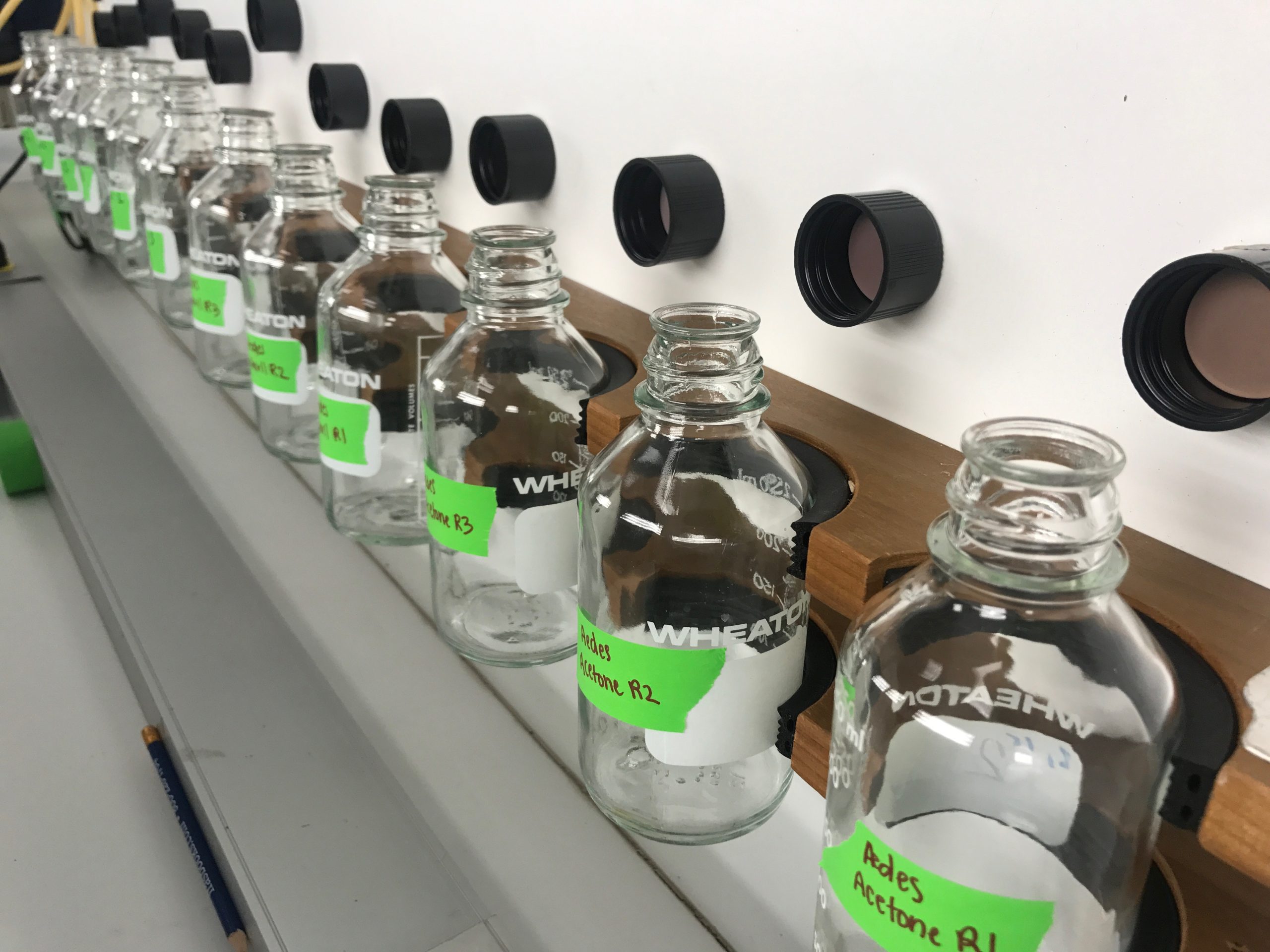
Here’s how it works: our team regularly collects mosquitoes from across the county and brings them into the lab for testing. Think of it as a check-up for mosquitoes, we’re looking to see if they’re still vulnerable to the products we use. One of the main tools is the CDC Bottle Bioassay, a tried-and-true test that shows how well different mosquito species respond to common pesticides (Brogdon & McAllister, 1998). It helps us catch early warning signs of resistance before it spreads.
If we do find resistance, we dig deeper. We test mosquitoes in more real-world settings, like semi-field and open-field trials, so we know whether our products still work outside the lab (Lucas et al, 2020; Lucas et al, 2022; Lucas et al, 2023, Lucas et al, 2024; McDuffie et al 2025). Sometimes, we even go a step further with specialized studies, looking at mosquito biology and genetics to uncover exactly why certain ones survive (Estep et al, 2018; Lucas et al, 2020).
And it’s not just about today’s products. Every new tool goes through the same careful vetting, whether it’s a chemical treatment, essential oils, mosquitofish, sterile male releases, or microbial larvicides. We figure out which species it works best against, the lowest dose that still does the job, and how it performs in real neighborhoods. The use of new products always start small, in test areas, before we roll them out district-wide.
By combining laboratory research, field testing, and careful product use, we make sure every tool in our toolbox is effective, cost-efficient, and sustainable, which in turn protects both people and the environment.
What happens if you don’t have effective resistance management?
If we don’t track pesticide resistance in local mosquitoes and adapt our control measures, we leave the door open for serious public health threats.
When Zika virus swept through Florida in 2016, no one knew how resistant the main culprit, Aedes aegypti, had become. By the time scientists tested mosquitoes in Miami-Dade, they discovered that local populations were already highly resistant to permethrin and other pyrethroid products (McAllister et al, 2020), a pattern seen across the entire state (Estep et al, 2018; Parker et al, 2020). Unfortunately, those very products had already been used on the ground to fight the outbreak, which meant treatments weren’t nearly as effective as hoped. The mosquitoes survived, and Zika kept spreading.
The turning point came when mosquito control programs shifted strategy. Instead of relying on ground-based permethrin, they combined truck and aerial applications of wide-area larvicides and switched to aerial treatments with a different class of product, the organophosphate naled. That integrated, science-based approach broke the transmission cycle and stopped local spread of Zika (McAllister et al, 2020).
This case drives home a simple truth: resistance monitoring and integrated mosquito management aren’t optional, they’re the difference between stopping a disease in its tracks or letting mosquitoes get ahead.
Fortunately, programs across Florida, including CMCD, took these lessons to heart. Today, we’re equipped with detailed resistance maps and a broad toolbox of methods, allowing us to target each mosquito species based on its unique vulnerabilities.
Do we have pesticide resistance in Collier County?
So, do we have resistant mosquitoes here in Collier County? The answer is yes, but it’s complicated. Resistance depends on the species, the product, and even the neighborhood. For example, Aedes aegypti and Culex quinquefasciatus, two important species in our area, have shown resistance to pyrethroid-based products (Estep et al, 2018; Lucas et al, 2020–2024; Parker et al, 2020; Schluep & Buckner, 2021; Watkins et al, 2021; McDuffie et al, 2025).
That’s why CMCD rotates products and uses multiple tools, tailoring our approach to the local situation to make sure control stays effective.
In next week’s blog post, we’ll explore the primary factors driving pyrethroid resistance in our mosquitoes — and, spoiler alert — it’s not CMCD’s practices.
Integrated Mosquito Management: Smarter Protection for Our Community
Combatting resistance to control measures takes more than one tool, it takes a whole toolbox. That’s why CMCD uses an approach called Integrated Mosquito Management, where different methods work together to keep mosquito populations under control while preventing resistance from developing.
It begins with prevention, like removing standing water, using safe, targeted larvicides, and using biological controls like mosquitofish. In targeted situations, innovative tools such as Sterile Insect Technique are being tested to limit reproduction. When chemical treatments are needed, we rotate active ingredients and carefully select the right product for the right mosquito species. It’s like changing the “lock” so the “key” mosquitoes have no longer works. This helps ensure our products remain effective long-term.
Integrated Mosquito Management allows us to protect public health while being responsible stewards of the environment and taxpayer dollars.
Working together to stay ahead
Fighting mosquitoes is a team effort between mosquito control programs, scientists, and our partners across the state and nation. That’s why we work closely with experts at places like the UF-IFAS Florida Medical Entomology Laboratory, the CDC, and the USDA. Together, we study pesticide resistance, test new strategies, and stay on top of the latest science.
By sharing knowledge and tapping into cutting-edge research, we can apply the most effective strategies right here in Collier County. These collaborations help ensure that our mosquito control efforts remain strong, efficient, and sustainable—protecting our community today and for the future.
References
Brogdon WG, McAllister JC. 1998. Simplification of adult mosquito bioassays through use of time-mortality determinations in glass bottles. J Am Mosq Control Assoc. 14, 159–164.
Estep AS, Sanscrainte ND, Waits CM, Bernard SJ, Lloyd A, Lucas KJ, Buckner E, Vaidyanathan R, Morreale R, Conti L, Becnel JJ. (2018) Quantification of permethrin resistance and kdr alleles in Florida populations of Aedes aegypti (L.) and Aedes albopictus (Skuse). PLoS Neg Trop Dis. 12(10): e0006544.
Lucas KJ, Bales RB, McCoy KD, Weldon C. (2020) Oxidase, esterase and kdr-associated pyrethroid resistance identified in Culex quinquefasciatus field collections from Collier County, Florida. J Am Mosq Control Assoc. 36(1):22–32.
Lucas KJ, Bales RB. (2022) Insecticide resistance evaluation of Aedes aegypti mosquitoes from Collier County, Florida. Arthropod Management Tests. 47(1).
Lucas KJ, Babcock E, Bales RB. (2023). Baseline susceptibility and effectiveness of adulticides to local Aedes taeniorhynchus from Collier County, Florida. J Am Mosq Control Assoc. 39: 212-15.
Lucas KJ, Heinig R, Lake L, Williams K, Parker-Crockett C, Bales RB, Decyo McDuffie. (2024) Evaluation of a novel triple-action adulticide containing a pyrethroid, macrocyclic lactone, and fatty acid against pyrethroid-resistant Aedes aegypti and Culex quinquefasciatus (Diptera: Culicidae). J Med Entomol. 61: 701-709.
McAllister JC, Porcelli M, Medina JM, Delorey MJ, Connelly CR, Godsey MS, Panella NA, Dzuris N, Boegler KA, Kenney JL, Kothera L, Vizcaino L, Lenhart AE, Mutebi JP, Vasquez C. 2020. Mosquito Control Activities during Local Transmission of Zika Virus, Miami-Dade County, Florida, USA, 2016. Emerging Infectious Diseases. 26: 881–890.
McDuffie D, Kacinskas S, Li S, Parker-Crockett C, Lucas KJ. 2025. Evaluation of Ground and Aerial Ultra-Low Volume Applications Using ReMoa Tri Against Deltamethrin-Resistant Aedes aegypti from Collier County, Florida. Trop Med Infect Dis 10: 119.
Parker C, Ramirez D, Thomas C, Connelly CR. (2020) Baseline Susceptibility Status of Florida Populations of Aedes aegypti (Diptera: Culicidae) and Aedes albopictus. J Med Entomol. 57: 1550-1559.
Schluep SM, Buckner EA. (2021) Metabolic Resistance in Permethrin-Resistant Florida Aedes aegypti (Diptera: Culicidae). Insects. 12: 866.
Watkins A, Babcock E, Lucas KJ. (2021) Ornamental bromeliads of local Botanical Gardens serve as larval production sites for pyrethroid-resistant Culex quinquefasciatus in Collier County, Florida. J Florida Mosq Control Assoc. 68: 14-23.
Decyo McDuffie, MS, is the Manager of Field Validation for the Collier Mosquito Control District and a medical entomologist with a Master of Science in Entomology from the University of Florida. He specializes in developing and applying innovative tools to reduce mosquito populations and in managing pesticide resistance to keep control efforts effective.