
Blog
Partners, Not Heroes: The Real Role of Dragonflies in Mosquito Control
Keira J. Lucas, PhD
Deputy Executive Director
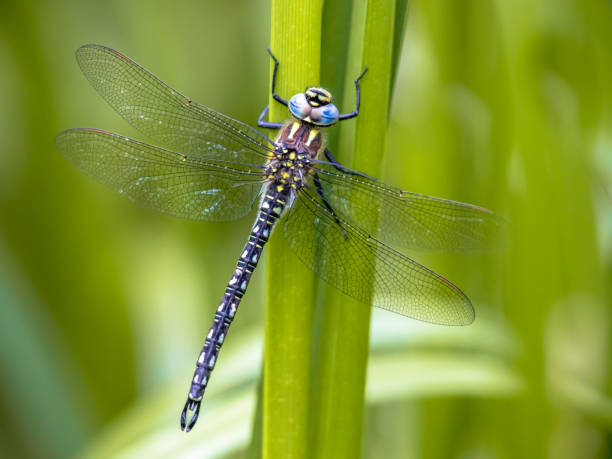
Dragonflies are often celebrated as nature’s mosquito hunters, and with good reason: both as aquatic nymphs and flying adults, dragonflies are skilled predators that feed on other insects, including mosquitoes. This has given rise to two persistent myths: 1. CMCD releases dragonflies to fight mosquitoes, and 2. Dragonflies can significantly reduce mosquito numbers in our area. While studies and observations clearly show that dragonflies do eat mosquitoes (Priyadarshana and Slade, 2023; Onen et al, 2024), there are important limitations that make them unreliable as a catch-all solution for mosquito control.
A Persistent Old Wives’ Tale
One of the most common myths we hear is that CMCD releases dragonflies to control mosquitoes. Residents even call on us to “drop the dragonflies,” as if we’ve got crates of them strapped into our planes, ready to parachute into action. It paints a hilarious mental picture: our pilots opening the hatch mid-air while squadrons of dragonflies leap out like tiny paratroopers, executing a precision mosquito strike. As entertaining as that sounds, it’s pure fiction.
This “old wives’ tale” seems to come from a well-timed coincidence: dragonflies often emerge right after the first big waves of mosquitoes emerge. Their perfectly timed arrival makes it look like they were deployed for mosquito duty, but we promise, no dragonfly air drops have ever happened in Collier County. While it makes for a fun and imaginative story, releasing dragonflies to control mosquitoes isn’t just unlikely, it’s wildly impractical.
Why Releasing Dragonflies Doesn’t Work
Dragonflies are amazing insects, but they’re not easy to raise or use for mosquito control. Dragonflies have complex life cycles and highly specific habitat needs that make them difficult to raise and release in any meaningful scale (Jourdan et al, 2019). Most of their life is spent as aquatic nymphs, living in ponds or wetlands for months or even years. These nymphs are territorial, predatory, and require clean, stable aquatic environments. Simply adding dragonfly nymphs into random bodies of water won’t guarantee they’ll live, let alone control mosquitoes.
In fact, a mosquito control program in Maine recently tried using dragonfly nymphs for mosquito control by outsourcing them from a third-party vendor (Lubelczyk et al, 2020). The results? A resounding defeat – no noticeable difference in mosquito larvae between treated and untreated areas. Worse, the attempt raised concerns about accidentally introducing non-native species, which can cause serious environmental problems.
Adult dragonflies, meanwhile, are powerful and mobile flyers but they are bad at taking orders. Even if you could release them in high numbers (which you can’t), there’s no way to make them stay in the area or focus exclusively on mosquitoes. They’ll fly off, follow the wind, or simply feast on whatever flying insects are most available. Their allegiance lies with their stomachs, not mosquito control.
Dragonflies are Outnumbered by Mosquitoes
While dragonflies do eat mosquitoes, they just don’t eat enough to put a dent in the massive mosquito populations we see here in Southwest Florida. In the best possible conditions (like in a controlled lab where mosquito larvae are the only food available), research shows that a single dragonfly nymph eats about 40 mosquito larvae per day on average (Priyadarshana and Slade, 2023). That might sound impressive, but what works in the lab doesn’t always hold up in the real world, and it definitely doesn’t even come close to keeping up with the numbers we deal with in Collier County, where mosquito larval density can reach upwards of 2 billion mosquitoes per acre of wetlands.
When it comes to adult dragonflies, there isn’t much research on exactly how many mosquitoes they catch and eat each day in the real world. Some estimates suggest they might eat anywhere from 30 to 100 mosquitoes daily. However, the National Park Service points out that, based on the size of a typical dragonfly’s stomach, the real number is probably much closer to the low end of that range (NPS, 2025).
And the challenge goes deeper than just appetite. Dragonflies have long, slow life cycles. They spend most of their lives underwater as nymphs, developing over months or even years in clean, stable ponds or wetlands. Meanwhile, mosquitoes are the definition of fast-breeding pests, multiplying at rates that put rabbits to shame, with most species going from egg to biting adult in under a week. So even if dragonflies are present and eating some mosquitoes, their slow development means they’re often outpaced and outnumbered by the mosquito population. The mosquitoes multiply much faster than dragonflies can grow, let alone start hunting. In short, by the time a dragonfly finishes basic training, the mosquitoes have already launched a full-scale offensive.
So, while dragonflies do eat mosquitoes, they don’t eat enough to meaningfully reduce the large mosquito populations seen in Southwest Florida.
Want to see how this plays out in the real world? Just visit the Florida Everglades in the summer, which is home to healthy populations of both dragonflies and mosquitoes. It’s the perfect battlefield to test their mettle. You’ll quickly notice that the dragonflies aren’t winning the battle against the mosquito swarms. So yes, dragonflies are fascinating and beneficial parts of the ecosystem but if you’re headed out there, don’t forget the bug spray!
A Valuable Partner, Not a Strategy We Can Depend On
That said, dragonflies are great to have around. Encouraging dragonfly-friendly habitats, like ponds with native plants and clean water, helps support a healthy, biodiverse environment that can naturally put some pressure on mosquito populations. In that sense, dragonflies are excellent partners in an integrated mosquito management program, but they are not, and never have been, the main act.
When it comes to real mosquito control, we need more than folklore and friendly flyers. We need strategic operations and science-based strategies: surveillance, education, source reduction, proven biological tools like mosquitofish and microbials, and precision use of larvicides and adulticides. These are our heavy artillery. Dragonflies are beautiful allies, but they were never meant to lead the charge.
Wait… If Dragonflies Are Collateral Damage from Aerial Treatments, How Can They Live Up to Their Mosquito Control Potential?
This is a common misconception, but in reality there’s no evidence that our mosquito control efforts harm dragonflies. Scientific studies that examine natural insect populations before and after treatment show that the precautions we take, such as using ultra-low volume (ULV) applications and carefully timing our treatments, are effective in protecting non-target species. These measures have been shown not to impact medium and large-bodies insects like dragonflies, butterflies, spiders, or honeybees at the population or ecosystem level (Jensen et al, 1999; Boyce et al, 2007; Davis and Peterson, 2008; Schleier and Peterson, 2010; Rochlin et al, 2022; Hart et al, 2024).
In fact, dragonflies hold their ground even when mosquito control missions are underway. Research has consistently shown that their populations remain stable, or even increase, following mosquito control treatments. One study (Boyce et al, 2007) found that aerial applications of synergized pyrethroids had no effect on these larger insects. Another study found that dragonflies increased in populations over the study period of five repeated aerial applications of naled (Rochlin et al, 2022). More recent research has shown that ground applications of pyrethroids also didn’t reduce the number of non-target insects like dragonflies post-treatment (Hart et al, 2024).
In short, our operations are designed to target mosquitoes specifically, and we take great care to avoid harming beneficial or non-target species like dragonflies. Importantly, all these studies confirmed that mosquito populations were successfully reduced at the time of treatment, showing that the products worked as intended without harming other wildlife (Jensen et al, 1999; Boyce et al, 2007; Davis and Peterson, 2008; Schleier and Peterson, 2010; Rochlin et al, 2022; Hart et al, 2024).
Our goal is to protect public health and comfort by controlling mosquitoes, and we work hard to do it in a way that also protects natural mosquito predators.
For more information on dragonflies in Florida, please visit: https://gardeningsolutions.ifas.ufl.edu/design/gardening-with-wildlife/dragonflies/
References
Boyce WM, Lawler SP, Schultz JM, McCauley SJ, Kimsey LS, Niemela MK, Nielsen CF, Reisen WK. 2007. Nontarget effects of the mosquito adulticide pyrethrin applied aerially during a West Nile virus outbreak in an urban California environment. J Am Mosq Control Assoc. 23: 335-339.
Davis RS, Peterson RKD. 2008. Effects of single and multiple applications of mosquito insecticides on nontarget arthropods. J Am Mosq Control Assoc. 24: 270-280.
Hart JD, Pandolfi A, Jones T, Jenkins DG. 2024. Ground-Based Pyrethroid Adulticides Reduce Mosquitoes But Not Nontarget Insects in Central Florida. J Am Mosq Control Assoc. 40:125-136.
Jensen T, Lawler SP, Dritz DA. 1999. Effects of ultra-low volume pyrethrin, malathion and permethrin on non-target invertebrates, sentinel mosquitoes, and mosquitofish in seasonally impounded wetlands. J Am Mosq Control Assoc. 15: 330-338.
Jourdan J, Plath M, Tonkin JD, Ceylan M, Dumeier AC, Gellert G, Graf W, Hawkins CP, Kiel E, Lorenz AW, Matthaei CD, Verdonshot PFM, Verdonschot RCM, Haase P. 2019. Reintroduction of freshwater microinvertebrates: challenges and opportunities. Biol Rev. 94: 368-387.
Lubelczyk CB, Elias SP, deMaynadier PG, Brunelle PM, Smith LB, Smith Jr, RP. 2020. Importation of Dragonfly Nymphs (Odonata: Anisoptera) to Control Mosquito Larvae (Diptera: Culicidae) in Southern Maine. Northeastern Naturalist. 27: 330-343.
Onen H, Kaddumukasa MA, Kayondo JK, Akol AM, Tripet F. 2024. A review of applications and limitations of using aquatic macroinvertebrate predators for biocontrol of the African malaria mosquito, Anopheles gambiae sensu lato. Parasit Vectors. 17: 257.
Priyadarshana TS, Slade EM. 2023. A meta-analysis reveals that dragonflies and damselflies can provide effective biological control of mosquitoes. J Animal Ecology. 92: 1589-1600.
Rochlin I, White G, Reissen N, Martheswaren T, Faraji A. 2022. Effects of aerial adulticiding for mosquito management on nontarget insects: A Bayesian and community ecology approach. Ecosphere. 13: e3896.
Schleirer JJ III, Peterson RKD. 2010. Toxicity and risk of permethrin and naled to non-target insects after adult mosquito management. Ecotoxicology. 19: 1140-1146.
National Park Service [NPS]. Species Spotlight – Dragonflies. Accessed: July 21, 2025. Website: https://www.nps.gov/articles/species-spotlight-dragonflies.htm
—
Dr. Keira Lucas serves as the Deputy Executive Director of the Collier Mosquito Control District, bringing a background in vector biology. She specializes in mosquito reproduction and biology, integrated pest management and pesticide resistance management, with experience in applying science-based strategies for effective and sustainable mosquito control.